

[popup_trigger id=”12600″ tag=”p” classes=”text-center font-blue”]中文摘要 / Summary in Chinese[/popup_trigger]
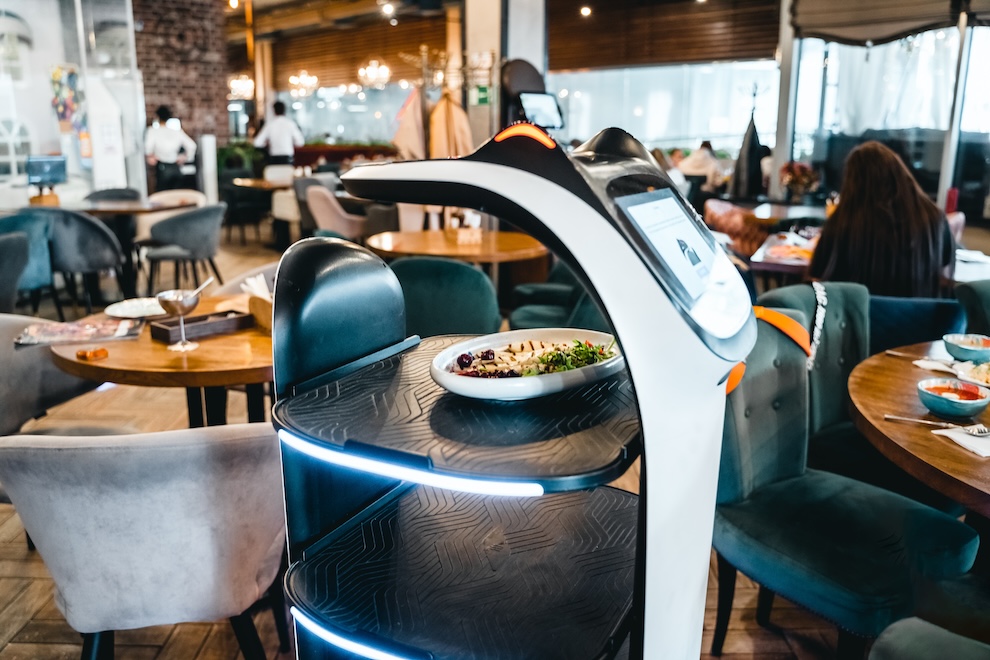
A study involving UTM Assistant Professor Dr. June Yang Huijun has investigated how service robots are perceived by customers in restaurants, highlighting how clients’ views depend on what task the robots are performing. The research also indicated robots are more readily accepted by restaurant users in theme parks
Restaurant managers considering the use of robots for services to customers must “understand which functions and types of service outlets are best suited for service robots.” The recommendation comes from a new study involving Dr. June Yang Huijun, Assistant Professor at UTM.
“Robot–environment fit should be considered when developers design – and managers select – robots for their restaurants,” the researchers stated.
The study was conducted by an international team. It also included: Dr. Wang Yao-Chin from the Department of Tourism, Hospitality and Event Management at the University of Florida, in the United States; Dr. Song Hanqun from the Essex Business School at the University of Essex, in the United Kingdom; and Dr. Emily Ma Jintao from the School of Hospitality and Tourism Management at the University of Surrey, in the U.K.
Their findings were published in the August issue of the International Journal of Contemporary Hospitality Management, in a paper titled “Utilitarian vs Hedonic Roles of Service Robots and Customer Stereotypes: A Person–Environment Fit Theory Perspective”. (Click here for access to the full paper.)
The study examined the differences in how restaurant customers responded to service tasks performed by human employees versus robots. It also explored customer stereotyping of service robots.
The research included two scenario-based experiments, focusing on different hypothetical restaurant settings. The first involved a casual restaurant in China, while the second was ‘set’ in a theme park restaurant. Participants were randomly assigned to either of the experimental scenarios and asked to assess it, and provide background information.
In total, 223 valid responses were gathered for the first study, with 213 valid responses in the second. Online marketing research company Wenjuanxing helped with data collection, which took place in China.
The results revealed that human staff in “hedonic services” – those involving social and emotional elements – enhanced customers’ perceptions of service and brand authenticity more than robotic counterparts. However, in utilitarian services, where tasks were functional and instrumental, there was “no significant difference” between client perceptions of human servers and robots in the theme park setting.
“Our findings indicate that customers in China may not be fully receptive to service robots in certain aspects of dining experiences,” the researchers said, emphasising that the service context played a crucial role in how robots were perceived. “Chinese consumers seem to have higher levels of acceptance of service robots in theme parks than in traditional restaurants,” they added.
The impact of stereotypes
The study highlighted the financial risks associated with introducing service robots to restaurant operations, suggesting that venue managers should carefully consider their suitability for specific functions and for the type of service outlet. Additionally, the researchers warned that – based on their findings – customer stereotypes regarding robots could significantly impact those customers’ perceptions of restaurant service.
Customers holding few stereotypical views about service robots “tend to perceive higher levels of brand and service authenticity,” the study noted.
To mitigate negative stereotypes, the authors suggested identifying positions in restaurants and other service contexts that may be influenced by customer and employee bias. This could help managers decide which roles are better suited for robots and which for humans.
“Only when customers understand that service robots can perform well in restaurants and other service contexts, particularly for standardised functions such as cleaning and food delivery, can negative stereotypes be minimised and service experiences with robots be enhanced,” the researchers stressed.
As the research found customers recognised the effectiveness of service robots as being on par with human staff in theme park restaurants, the authors suggested that robots could be used to help reduce labour costs while maintaining customer satisfaction in these environments. They added that collaboration between service automation developers and theme park managers could enhance the integration of robots into these complexes.
In addition, it was found that customers in theme parks viewed robots as capable of delivering quality hedonic services which they perceived as fitting with the service and brand authenticity of both the restaurant and the theme park itself.
“Therefore, service automation technology developers should design robots that can fit with the service image of theme park restaurants and the theme park brand image,” the team of researchers concluded.
Editor: UTM Public Relations Team