


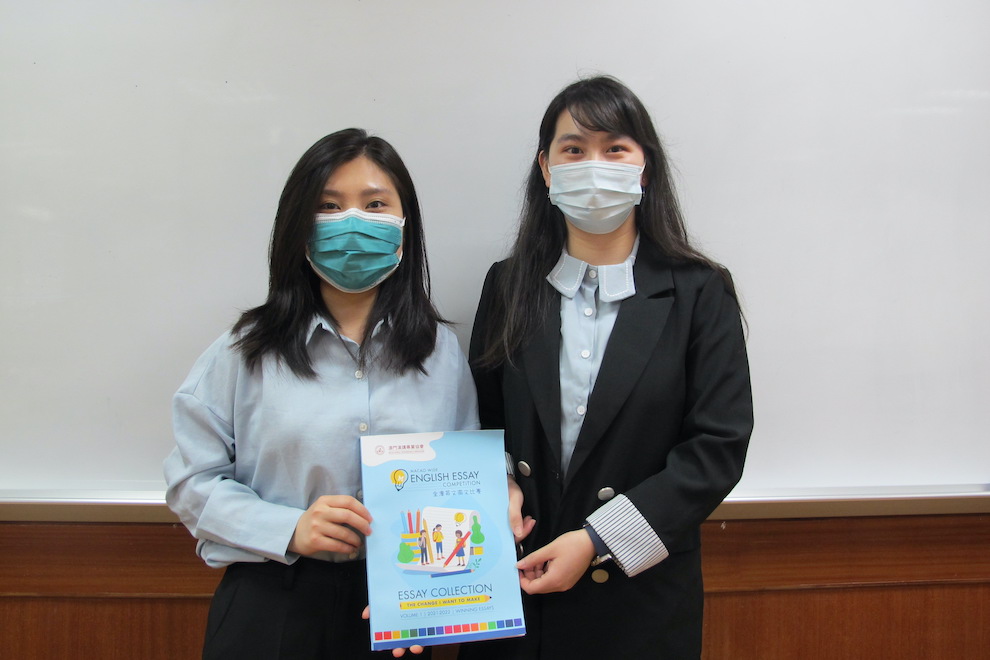
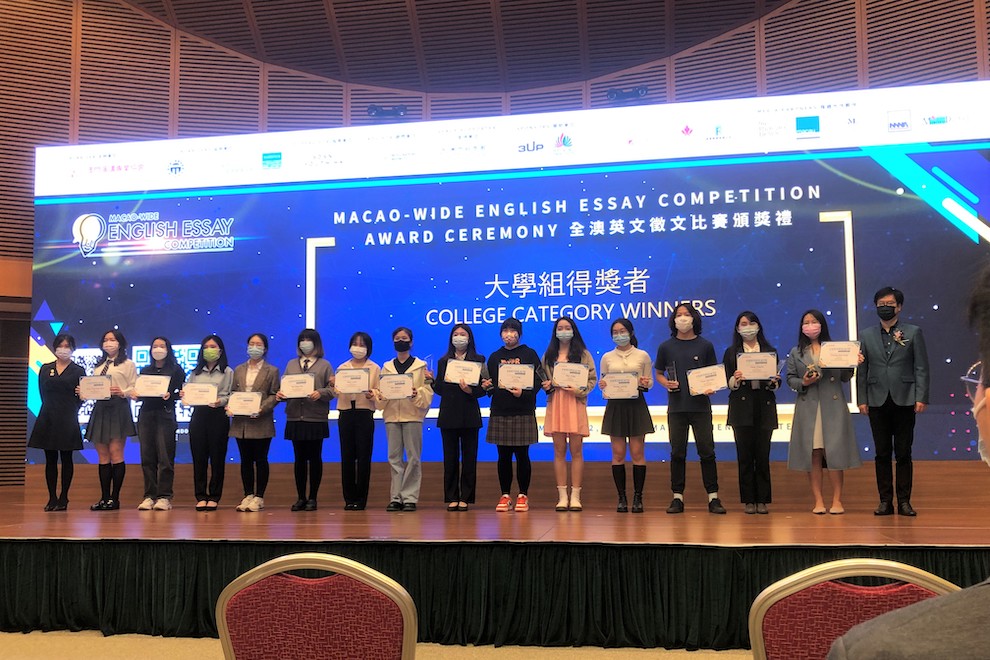
Two IFTM students each had their work recognised as outstanding in the college category of the 2021-2022 Macao-Wide English Essay Competition. Sophia Yang Ying Qi was placed second, while Eva Lin Yihua received an honourable mention. Both undergraduates are from IFTM programmes that use English as the medium of teaching.
The results were announced in March. The competition, organised by the Macau Speech Professionals Association, invited participants to discuss in essay form the Sustainable Development Goals set by the United Nations. Those are presented as a collection of 17 interlinked global goals designed to be a “blueprint to achieve a better and more sustainable future for all”.
Sophia, a Year 4 student from the English-language stream of the Hotel Management Bachelor’s Degree Programme, focused her essay on 2 particular goals: “ensure access to affordable, reliable, sustainable and modern energy for all”; and “take urgent action to combat climate change and its impacts”.
The IFTM student says that, in preparing to write her essay, she read many academic papers on sustainability, to gain an in-depth understanding of the topic. “I’m interested in sustainability-related issues,” she explains.
Having already completed many projects and presentations for courses at IFTM using English as medium, Sophia felt comfortable writing an essay in English. The work beforehand at the Institute “helped me a lot in terms of developing my English writing and communication skills,” she says.
Nevertheless, hers was a complex, academic-style essay, with a need for a specific set of writing skills. Whenever she found challenges in terms of sentence structuring, vocabulary usage and other issues, she resorted to IFTM’s English Centre for help.
Lecturer Ms. Gabriella Cheang Si Weng, one of the IFTM scholars providing student support there, praises Sophia for her “eagerness” to learn new things. “I can see she likes to explore beyond everyday English.”
Path for improvement
Fellow contest participant Eva also structured her essay around 2 Sustainable Development Goals, hers being “ensure inclusive and equitable quality education and promote lifelong learning opportunities for all”, and “achieve gender equality and empower all women and girls”. But the Year 3 student from the Heritage Management Bachelor’s Degree Programme did not produce an academic essay; instead, she drafted an article expressing her personal views on these topics.
“It was a combination of my experience, feelings, and some inspiration gained through every step of growing up,” Eva says. She especially talked about her experience as a volunteer supporting English-language teaching in a poor area of the Mainland.
“In writing this article, my biggest problem was that I had too many ideas that I wanted to share. However, once I put those things on the paper, I didn’t know how to organise them,” she recalls.
This is a common problem faced by students that use Chinese as their first or main language, says Ms. Cheang. It is related to a tendency to employ a similar style when writing in English as they would when writing in Chinese. That includes providing a lot of background information at first, and only tackling the main idea of the essay toward the end part. “But when we write in English, the first part already should highlight the main topic; only after that, we select some other useful add-ons to include in the article,” the scholar explains.
Ms. Cheang applauds the interest displayed by both Sophia and Eva in improving their English-language skills. “The experience from having participated in the competition definitely will help them in writing their respective graduation theses,” she says. “In addition, their work was recognised, and they became more confident because of that.”


攻讀酒店管理學士學位-74x55.jpeg)
