

[popup_trigger id=”12501″ tag=”p” classes=”text-center font-blue”]中文版本 / Chinese version[/popup_trigger]
New research highlights importance of adaptive co-management for pandemic mitigation and tourism recovery in the Greater Bay Area
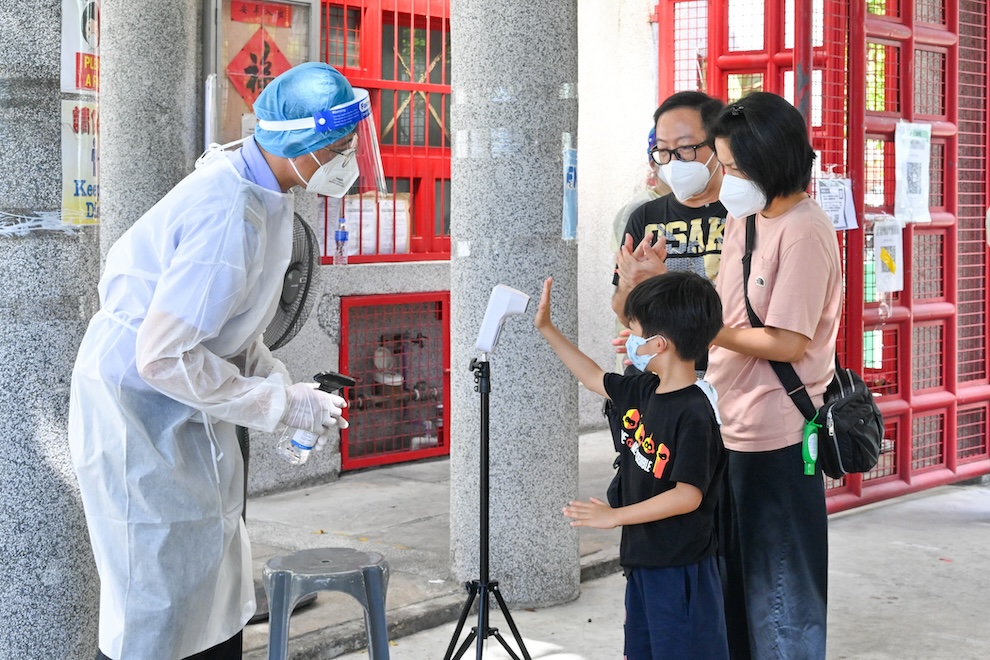
A study published in October in the Journal of China Tourism Research – involving a trio of scholars from IFTM – sheds light on the pivotal role of so-called ‘adaptive co-management’ in striking a balance between pandemic control measures and the revival of the tourism industry within the Guangdong-Hong Kong-Macao Greater Bay Area during the COVID-19 crisis. The research pointed to how a mix of institutional arrangements – from intra-governmental collaboration to inter-governmental cooperation within the region, supported by interactive and iterative learning – had led to improved decision-making and enhanced learning and adaption in relation to the pandemic.
The research was by Prof. Penny Wan Yim King, Dr. Virginia Lau Meng Chan, and Dr. Li Xiangping of IFTM, in collaboration with Dr. Jie Li from Sun Yat-sen University in mainland China’s Guangdong province. It underscored the success of collaborative efforts at multiple governmental levels in navigating the challenges posed by COVID-19, while fostering the recovery of the tourism industry in the Greater Bay Area.
The paper, titled “Adaptive Co-Management for Regional Tourism Governance Under the COVID-19 Pandemic in the Greater Bay Area, China”, highlighted how adaptive co-management was used by actors and institutions specifically in the Macao and Guangdong province portions of the Greater Bay Area, to guide the region’s recovery from the impact of COVID-19. This included a gradual resumption of cross-border travel between Macao and Zhuhai, supported by a transformation in tourism models, after the initial COVID-19-related border closures.
As part of their research, the team conducted qualitative in-depth interviews with 19 representatives from various government departments in Macao and Guangdong. The study was financially supported by IFTM, and was the result of institutional collaboration between IFTM and Sun Yat-sen University.
“Results demonstrated how actors and flexible institutions at multiple geographical scales and levels had joined efforts to cope with the various phases of uncertainty through a learning-by-doing process,” wrote the researchers. For instance, in Macao, the city’s Chief Executive, Ho Iat Seng, established two cross-departmental task forces to tackle pandemic-related issues. The Joint Prevention and Control Mechanism Team oversaw intra-governmental collaboration, while the Macao–Zhuhai COVID-19 Prevention Control Working Group coordinated the work of the authorities from both cities in implementation of pandemic countermeasures, exemplifying inter-governmental cooperation.
“In each phase of uncertainty arising from the pandemic, there have been different challenges that required actors and institutions to assess and understand the challenges, set the goals and aims, and develop the appropriate forms of alliances within the region,” for the purposes of adaptation, wrote the researchers. The adaptive learning and co-management method was “particularly relevant and helpful in tourism governance during the pandemic because of its capacity to cope with the various phases of uncertainty,” they added.
Fundamentals of adaptive co-management
The researchers explained that adaptive co-management drew on stakeholders’ resources and collaboration in decision-making. It involved joint management through learning-by-doing, with participants collaboratively handling problems and crises.
The study suggested that adaptive co-management could be utilised to “enhance regional integration through vertical and horizontal collaborations at different levels”. The researchers noted that during the COVID-19 public health alert, intra-governmental task forces had “played an important role in facilitating communications and execution” within hierarchical government structures. Such task forces “could be extended to handle other crises”, especially at moments when uncertainty is high, “when flexibility and prompt action are crucial”.
At the inter-governmental level, the joint task force between Macao and Zhuhai contributed to normalising cross-border activities by developing mutually-acceptable pandemic measures. Adaptive co-management encouraged adjacent cities, even those with different legislative systems, to overcome their differences and find solutions for compatibility, argued the scholars. Such inter-governmental task forces could “serve as a platform for interactive and iterative learning to enhance understanding, narrowing the institutional dissimilarity and accelerating the integration process within the region,” suggested the scholars.
The research team identified leadership and communication as essential facilitators in the adaptive co-management process. Strong government leadership could “expedite decision-making”, enable swift actions, and “signal determination” to resolve crises, especially when dealing with diverse stakeholder interests and incomplete knowledge, they wrote.
MORE INFO
[mks_tabs nav=”horizontal”]
[mks_tab_item title=”The researchers”]
Prof. Penny Wan Yim King is based at IFTM. She holds a PhD from the University of Hong Kong. Her academic research focuses on tourism governance and policy, accessible tourism, tourism planning and development, integrated resort management, and urban planning. Prof. Wan has served as an editorial board member and reviewer for several high-profile academic journals in the field of tourism.
Dr. Jie Li is an Associate Professor in the School of Tourism Management at Sun Yat-sen University, in Guangdong province, mainland China. She holds a PhD from the University of Hong Kong. Her research interests include tourism and urban development, metropolitan tourism, and mobility.
IFTM Assistant Professor Dr. Virginia Lau Meng Chan holds a PhD in business administration from the University of Saint Joseph, in Macao. Her academic research interests include employee stress and resilience, tourist experience and behaviour, networking and ‘guanxi’ within organisations, corporate social responsibility-related communication, and branding. Dr. Lau’s work experience includes accounting-related positions in the United States, Hong Kong, and mainland China.
Dr. Li Xiangping is an Assistant Professor at IFTM, where she is also the coordinator for the Tourism Business Management programme. Dr. Li has a PhD in Hospitality and Tourism Management from the Virginia Polytechnic Institute and State University, in Virginia, in the United States. Her research interests cover sustainable tourism development, destination marketing, and tourist behaviour.
[/mks_tab_item]
[mks_tab_item title=”The paper”]
Penny Yim King Wan, Jie Li, Virginia Meng-Chan Lau and Xiangping Li: “Adaptive Co-Management for Regional Tourism Governance Under the COVID-19 Pandemic in the Greater Bay Area, China”, Journal of China Tourism Research, published online, 2023.
https://doi.org/10.1080/19388160.2023.2266556[/mks_tab_item]
[/mks_tabs]
Editor: Research Corner | A partnership between Macau Business and IFTM