

[popup_trigger id=”12528″ tag=”p” classes=”text-center font-blue”]中文摘要 / Summary in Chinese[/popup_trigger]
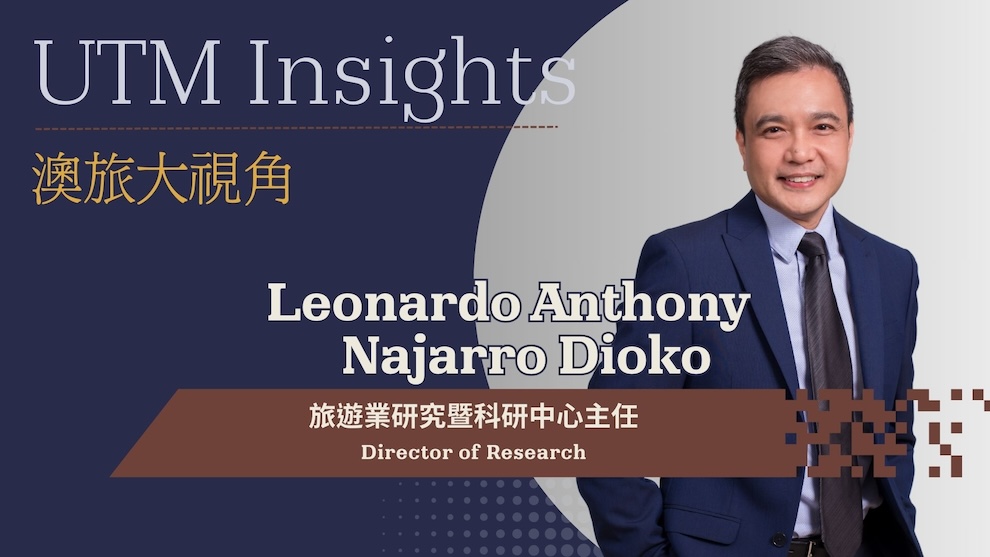
The International Centre for Tourism and Hospitality Research at UTM is helping shape Macao’s tourism policies. The centre, led by Prof. Leonardo Dioko, has also worked on collaborative projects with other institutions, including destination branding for the city and management of large volumes of visitors from elsewhere in the Greater Bay Area
UTM’s International Centre for Tourism and Hospitality Research has played a pivotal role in shaping the city’s tourism policies over the past two decades. Under the leadership of Prof. Leonardo (Don) Dioko, the centre has been at the forefront of evidence-based insights for policymakers, helping to steer Macao’s tourism development in a direction that prioritises sustainability.
“We don’t do research for the sake of research,” says Prof. Dioko. “We do it for the sake of policy improvement. That’s what has distinguished us and our work over the years.”
The research unit has long been part of UTM’s organisation, since the inception of UTM’s predecessor institution, the Institute for Tourism Studies, and was one of the first bodies to monitor and examine the city’s tourism sector, which was then beginning to flourish. As the industry rapidly grew in importance following the liberalisation of the casino industry, the centre’s role became increasingly crucial in addressing key challenges and issues arising from this transformation.
“The core of our research lies in measuring the impact of tourism on residents’ quality of life,” Prof. Dioko explains. “It’s also the core of government policymaking. As you can see from other destinations around the world, it has very serious implications.”
The centre’s research portfolio is diverse. Work best-known to the public includes the Macao Tourism Satisfaction Index (MTSI) – providing a deeper understanding of the profile of visitors – and the Human Resource Monitor, examining stress levels, job satisfaction, and career progression among hospitality and tourism industry workers.
Prof. Dioko cites several instances where the centre’s research has directly influenced policy decisions. Among these was to recommend the introduction of more pedestrianised areas in and around the city’s historic centre, a suggestion adopted to aid crowd management and safety purposes.
The centre’s research has also played a role in shaping labour relations in Macao. “Another example which we’re very proud of is that, before the pandemic, we regularly held briefings for the tourism and hospitality industry about the conditions for people working in this sector,” Prof. Dioko says. “Industry members actually tried to implement some of our recommendations, such as improving work-family balance for shift workers.”
The COVID-19 pandemic and related restrictions impacted the centre’s research activities, but Prof. Dioko is now leading the process of restarting key projects, including its long-running annual ‘tourism carrying capacity’ study. Such type of study seeks to estimate the optimum number of people that can visit a tourist destination simultaneously without causing deterioration of the physical, economic, and socio-cultural environment and an unacceptable decrease in the quality of visitors’ satisfaction.
“Spikes in visitation can cause a lot of impact in the local community,” Prof. Dioko says. “So, this is what we’re doing at the moment – monitoring, with greater intensity, the impact on the quality of life of residents.”
As Macao’s tourism industry rebounds from the COVID-19 pandemic, officials are working to change the profile of the city’s source markets and increase length of visitor stay.
“A lot of our source markets has always been the day trippers from nearby locations,” says Prof. Dioko. “But we have, in the past, recommended much more focus, for example, on meetings and conventions, because one of the challenges of Macao tourism has always been to increase the length of stay [of visitors].”
He adds: “Someone attending a conference in Macao for three or four days, that will ultimately move the needle of the length of stay, for example. Some other examples of these are medical tourism and even sports tourism.”
UTM is also collaborating with partners in the Guangdong-Hong Kong-Macao Greater Bay Area, such as Sun Yat-sen University in Guangdong, and The Hong Kong Polytechnic University, on destination branding and visitor mobility studies.
“Just before COVID, we did a research project on how you brand the Greater Bay Area as a destination, because you’ve got 11 cities competing,” Prof. Dioko says. “Do you subsume the Macao brand under this overall Greater Bay Area brand?”
Additionally, the UTM researchers are examining mobility patterns of visitors within the Greater Bay Area, using innovative technology in order to better understand congestion and crowding.
“We’re working together with Sun Yat-sen University on this,” Prof. Dioko says. “That helps us [Macao] with congestion and crowding. Macao’s problem has always been sudden surges of visitors, which are very hard to plan for.”
Editor: UTM Public Relations Team

攻讀酒店管理學士學位-300x168.jpeg)