


As the global tourism market gradually recovers, coupled with strong national policy support, the Greater Bay Area (GBA) is embracing unprecedented development opportunities. From post-pandemic shifts in consumer behaviour to the deep integration of advanced technologies, several noteworthy trends are emerging in the market.
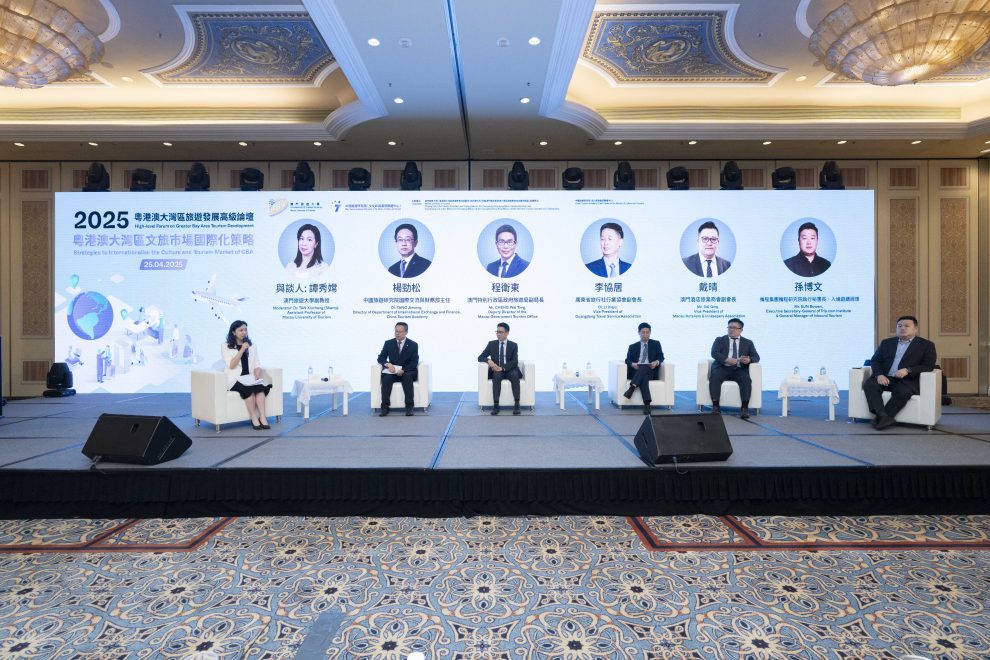
In collaboration with the China Tourism Academy, the Macao University of Tourism recently hosted the 2025 High-level Forum on Greater Bay Area Tourism Development during the 13th Macao International Travel (Industry) Expo. The forum, centred on the theme ‘Strategies to Internationalise the Culture and Tourism Market of GBA’, attracted over 150 government representatives, industry leaders, experts, scholars, and students.
Participants gathered to explore practical approaches to enhancing the international competitiveness of the GBA, accelerating tourism integration, and positioning the region as a world-class travel destination.
Risk Management and Market Adaptation in the Post-Pandemic Era
Yang Jinsong, Director of DOIE at the China Tourism Academy, emphasised that tourism operators must strengthen risk management capabilities post-pandemic to adapt to evolving consumer behaviour and navigate a less certain market environment.
“During the pandemic, uncertainty caused a substantial impact on both industry professionals and travellers, and this uncertainty has stayed on since the pandemic faded,” Yang said. “The key to industry operations is dispersing risks, particularly by leveraging controllable factors to alleviate uncertainties and turn challenges into opportunities.”
Technological Disruptions Reshaping the Tourism Landscape
The rapid advancements in artificial intelligence and social media are reshaping tourism competition, creating both growth opportunities and unpredictable challenges for traditional travel agencies.
“Faced with such uncertainty, without proper response strategies and deep understanding, the industry risks falling into passivity,” Yang further analysed. “We must focus on the level of technological penetration and its impact on different demographic segments. Whether we choose to embrace it or not, we are already deeply engaged in this transformation. The key is to adapt efficiently and seize emerging opportunities.”
Independent Travel and Micro-Vacations as Dominant Trends
Sun Bowen, Executive Secretary-General of the Trip.com Group Institute, pointed out that independent travel continues to rise, with short-distance “micro-vacations” gaining popularity, as travellers increasingly favour cost-effective tourism options.
“This trend is growing more prevalent, with one- to two-day short-distance getaways set to dominate,” Sun noted. “For example, some scenic spots in Guangdong are promoting a ’48-hour deep relaxation’ concept, and this trend is expected to expand across the Greater Bay Area.”
Sun further highlighted: “In addition, the GBA is experiencing an increase in ‘two-way travel’—mainland tourists visiting Hong Kong and Macau, while residents of Hong Kong and Macau travel north to mainland China for leisure. This will be a key development direction moving forward.”
“Coopetition Model” Driving GBA Tourism Synergy
Regarding intra-regional collaboration, Li Xieju, Vice President of the Guangdong Travel Service Association, noted that the GBA tourism sector is evolving under an innovative “coopetition” model, where cities compete yet collaborate to maximise mutual advantages.
“The GBA encompasses Guangzhou, Shenzhen, Hong Kong, and Macau, forming a culturally distinctive zone weaved in Lingnan heritage and Western influences. Each city has a unique development positioning and strengths,” Li explained.
“While competition exists, cooperation should be the dominant theme,” he emphasised. “Against the ‘one country, two systems, and three currencies’ background, the GBA exhibits strong differentiation. Cities should focus on their strengths rather than engage in a competition of homogeneity.”
He further elaborated: “As cross-provincial tourism continues to broaden, Guangdong, Macau, and Hong Kong should leverage their respective strengths to attract domestic travellers while targeting mid-range and long-haul international markets. This ‘coopetition’ model is central to the ‘Multicultural and Dynamic Bay Area’ branding initiative.”







攻讀酒店管理學士學位-74x55.jpeg)
